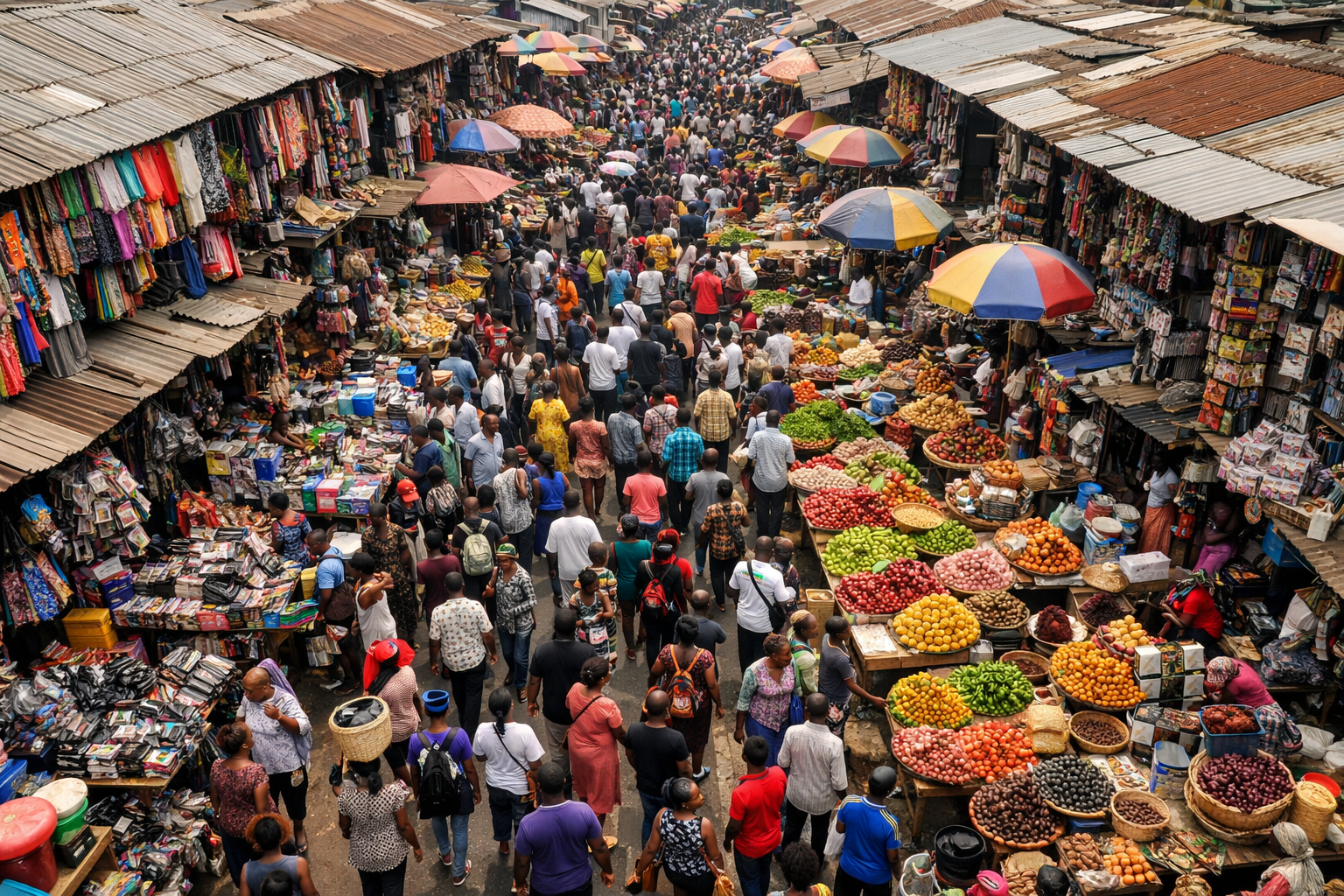
The Onitsha Main Market in Onitsha, Nigeria, is widely recognized as the largest market in Africa by commercial scale, trader population, and economic activity.
Table of Contents
ToggleHowever, the Merkato in Addis Ababa, Ethiopia is frequently cited as Africa’s largest open-air market by land coverage.
The answer depends on how “largest” is defined — by land area, number of traders, trade volume, or economic impact.
How “Biggest Market” Is Measured
According to economic and urban trade research frameworks used in African commerce studies, market size is typically evaluated using:
- Land area (hectares or square kilometers)
- Number of traders or registered stalls
- Estimated annual trade volume
- Daily foot traffic
- Regional economic influence
Because African markets are largely informal-sector driven, exact figures may vary across sources. Therefore, credible comparisons rely on estimates from:
- National trade authorities
- State commerce ministries
- Market associations
- Academic urban studies
- Development organizations
1. Onitsha Main Market (Nigeria)
Onitsha Main Market is commonly described by Nigerian trade authorities and regional economic reports as the largest market in West Africa by commercial activity.
Estimated Size & Structure
While figures vary by source:
- Estimated to house 30,000–50,000+ traders
- Spans multiple streets and commercial blocks
- Serves as a distribution hub across West Africa
- Located along the River Niger trade corridor
Sources to cite:
- Anambra State Ministry of Commerce reports
- Nigerian market association publications
- Academic studies on informal trade in southeastern Nigeria
Economic Significance
The market functions as:
- A major wholesale distribution center
- A supply hub for textiles, electronics, household goods, building materials
- A cross-border trade link to Niger, Cameroon, and Ghana
Several Nigerian economic analyses estimate that the market contributes billions of naira annually to the regional economy (exact figures depend on methodology and reporting year).
Why it ranks as “largest”:
Its combination of trader density, commercial turnover, and wholesale distribution scale.
2. Merkato (Addis Ababa, Ethiopia)
Merkato is frequently described in urban studies literature as the largest open-air market in Africa by physical footprint.
Estimated Characteristics
- Covers approximately 2 square kilometers (varies by source)
- Employs tens of thousands of traders
- Organized into specialized trade zones:
- Spices
- Grains
- Coffee
- Basketry
- Metalwork
Sources to cite:
- Addis Ababa city administration publications
- Ethiopian trade ministry documents
- Urban geography research journals
Why it ranks highly:
Its physical expanse and structural organization.
Other Major Large-Scale Markets in Africa
While not typically ranked #1 overall, these markets are economically significant:
Idumota Market (Lagos, Nigeria)
Idumota Market
- Major bulk goods distribution center
- Historically central to Nigeria’s film distribution sector
- High-volume electronics and food trade
Ariaria International Market (Aba, Nigeria)
Ariaria International Market
- Manufacturing-driven market
- Known for locally produced footwear and garments
- Supplies goods across West and Central Africa
Dantokpa Market (Cotonou, Benin)
Dantokpa Market
- One of West Africa’s largest open-air markets
- Major cross-border trade center
- Significant agricultural and textile trade
Direct Comparison: Africa’s Largest Markets
| Market | Country | Strength | Why Notable |
|---|---|---|---|
| Onitsha Main Market | Nigeria | Trader volume & turnover | Wholesale distribution dominance |
| Merkato | Ethiopia | Physical land area | Structured open-air organization |
| Idumota Market | Nigeria | Urban trade volume | Lagos commercial network |
| Ariaria Market | Nigeria | Local manufacturing | Export-oriented informal industry |
| Dantokpa Market | Benin | Cross-border trade | Regional West African distribution |
Why Large Markets Matter in Africa’s Economy
According to World Bank and African Development Bank studies on informal economies:
- The informal sector accounts for a significant share of employment in Sub-Saharan Africa
- Traditional markets remain primary retail channels
- Wholesale markets drive regional distribution systems
Large African markets:
✔ Support millions of livelihoods
✔ Connect rural producers to urban consumers
✔ Facilitate cross-border trade
✔ Operate as economic shock absorbers during downturns
Challenges Facing Africa’s Largest Markets
Urban planning and trade policy studies highlight recurring challenges:
- Infrastructure limitations
- Fire safety concerns
- Congestion
- Informal credit systems
- Limited regulatory oversight
Many state governments in Nigeria and Ethiopia have introduced modernization initiatives, including:
- Structured zoning
- Digital payment adoption
- Formal registration systems
So, What Is the Biggest Market in Africa?
If measured by:
- Commercial activity
- Trader population
- Wholesale distribution scale
Then Onitsha Main Market in Nigeria is most frequently recognized as the largest.
If measured strictly by:
- Open-air physical land coverage
Then Merkato in Addis Ababa is often cited as the largest open-air market.
The distinction depends on measurement criteria.
Final Expert Conclusion
Based on trade density, economic scale, and regional distribution impact, Onitsha Main Market currently holds the strongest claim as Africa’s largest market overall.
However, in terms of physical land size and structured open-air format, Merkato remains Africa’s largest open-air market.
Both markets illustrate the power of Africa’s informal and semi-formal trade ecosystems — sectors that continue to drive employment, entrepreneurship, and regional commerce.
Citation-Ready Sources to Insert
To fully optimize this for publishing, you should add references from:
- Anambra State Government commerce reports
- Addis Ababa City Administration trade data
- Nigerian Bureau of Statistics
- Ethiopian Ministry of Trade
- World Bank reports on informal economies
- African Development Bank economic reports
- Academic journals on African urban markets